Jon's comparison from the same slide, his estimate from a published report: Llama 3.2 1B at about 370,000 H100 hours and retail H100 rental of $2 to $4 per GPU-hour works out to $92 to $184 per billion tokens.
The live training register: parallax.chutes.ai
 Linkparallax.chutes.aiparallax.chutes.ai
Full post on TaosisOpen on X ↗
Pretraining a model used to mean a datacenter and a nine-figure budget. Jon did it on rented RTX 5090s over the open internet for $11.27 per billion tokens.
The whole 8B run came to about $6,500. Retail hourly GPU prices, 574B tokens, 52 hours. The syncers were four CPU VMs with no GPU in them, and there was no object store anywhere in the system.
If a model costs about what a used car costs, a lot more people get to own one. That's the point of Parallax.

Full post on TaosisOpen on X ↗
Week 22. The short version:
→ Jon published Epigenesis, a way to teach a Parallax model new facts without changing a single base weight. New knowledge gets written into the zero slots the compressed model already has. Zero the slots and the original model is back, bit for bit. On the hardest test, a 3.3 MB patch beat an 88 MB LoRA adapter on recall. Early results, single run, not peer-reviewed, nothing serves it yet
→ Lambda is still training. Seven hosts have failed so far and the run absorbed every one of them without a restart. Boring results like that are the whole point
→ Confidential VM 1.5.0 is out to miners. Every file that goes into building it is now pinned by hash, so anyone checking our published measurements rebuilds exactly what we measured
→ Hot-swap upgrades for private chutes shipped. Maintenance on our side should stop taking your model offline
→ AMD hardware still waits. Nothing changed in the bulletin this week
Each one below, with what it means if you are not an engineer 👇
Quoting @chutes_ai
x.com/i/article/2110393371424600064
Full post on TaosisRead the thread on X →Open on X ↗
Validator TAO.app (5CoZ…bifj) scheduled a child-key change on 125 subnets
Validator hotkey 5CoZxgtfhcJKX2HmkwnsN18KbaT9aih9eF3b6qVPTgAUbifj announced new child keys on SN1, SN2, SN3, SN4, SN5, SN6, SN7, SN8, SN9, SN10, SN11, SN12 and 113 more, applying at block 9,281,605 (~24h). Stake delegated to it there routes through its children after that.
ValidatorTAO.appSubnetsSN1, SN2, SN3, SN4, SN5, SN6, SN7, SN8, SN9, SN10, SN11, SN12, … (125 subnets) Between blocks 9,274,365 and 9,274,433
Validator Firepool (5Deo…zD9Y) scheduled a child-key change on 68 subnets
Validator hotkey 5Deo9Q3SnZWNPSEPRTgapbyy6egKu2oaNSqD4RQHHJEuzD9Y announced new child keys on SN4, SN6, SN8, SN9, SN15, SN16, SN17, SN19, SN21, SN23, SN27, SN29 and 56 more, applying at block 9,269,281 (~24h). Stake delegated to it there routes through its children after that.
ValidatorFirepoolSubnetsSN4, SN6, SN8, SN9, SN15, SN16, SN17, SN19, SN21, SN23, SN27, SN29, … (68 subnets) Between blocks 9,262,073 and 9,262,137
Validator Tensorplex Labs (5E4z…ULde) scheduled a child-key change on 23 subnets
Validator hotkey 5E4z3h9yVhmQyCFWNbY9BPpwhx4xFiPwq3eeqmBgVF6KULde announced new child keys on SN45, SN46, SN47, SN48, SN49, SN50, SN51, SN52, SN53, SN54, SN55, SN56 and 11 more, applying at block 9,265,512 (~24h). Stake delegated to it there routes through its children after that. On SN56 it replaces the change that was pending for block 9,262,122, which will not apply then.
ValidatorTensorplex LabsSubnetsSN45, SN46, SN47, SN48, SN49, SN50, SN51, SN52, SN53, SN54, SN55, SN56, … (23 subnets) Between blocks 9,258,311 and 9,258,378
Two weeks, one issue. The short version:
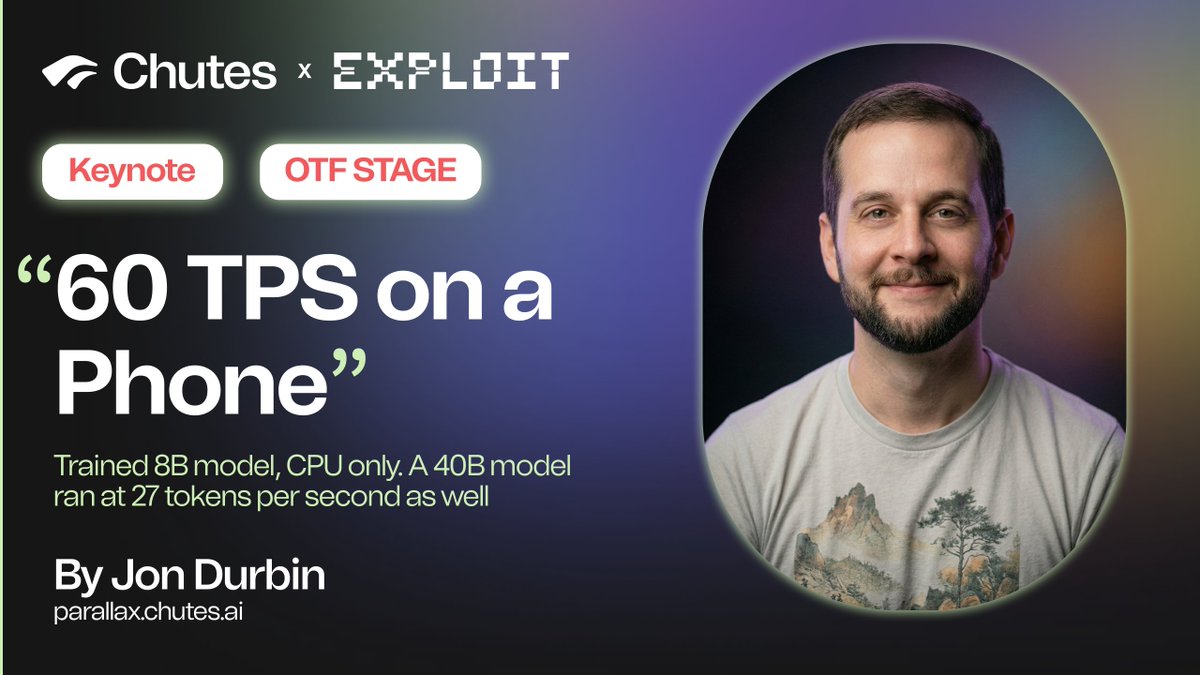
→ A model our team built ran on an ordinary phone, no cloud involved. Jon showed it at Exploit: Parallax on a Snapdragon 8 Elite, CPU only, 59.6 tokens a second, and nothing left the device. A datacenter has an off switch. A billion personal devices don't
→ A model we trained on scattered consumer graphics cards matched a big lab's model on several tests, for a fraction of the cost. Kappa passed Llama 3.2 1B at around 90 percent lower cost per token. Early results from one run
→ SOMA (SN114) is live on Chutes inference
→ AMD disclosed a security flaw in its chips, so our engineers chose to wait rather than switch them on. A chip that says it is patched is not the same as a chip that can prove it
Full details in the article below 👇
Quoting @chutes_ai
x.com/i/article/2107874751616364544
Full post on TaosisRead the thread on X →Open on X ↗
Validator 88 Root (5Djt…T4Kd) scheduled a child-key change on 7 subnets
Validator hotkey 5DjtmV76CRvxZqd68fDwWyTmsfqUZ5EUXVJ21FKTBzwLT4Kd announced new child keys on SN54, SN55, SN56, SN58, SN61, SN63, SN64, applying at block 9,216,240 (~24h). Stake delegated to it there routes through its children after that.
Validator88 RootSubnetsSN54, SN55, SN56, SN58, SN61, SN63, SN64 Between blocks 9,209,038 and 9,209,099
Parallax: Building the Decentralized "Linux of AI" With No Off Switch | Jon Durbin at Exploit
Jon Durbin closes Day 1 of Exploit with a case for open, resilient and ubiquitous artificial intelligence. Starting with his personal motivation for building Chutes and Parallax, Jon examines the physical and economic limits of centralized AI infrastructure: data-center expansion, power constraints, consolidation of the open-source stack, privacy, dependence on open-weight models and the difficulty of decentralized training. He then introduces Parallax, an approach to decentralized model training designed around systems with no single off switch. The architecture combines sparse mixture-of-experts models, ternary weights, low-bandwidth distributed training and commodity hardware with the goal of making inference extremely fast, cheap and widely available. The thesis: reduce the cost of intelligence toward the cost of the energy required to produce it, make models reproducible and auditable, and build what Jon describes as the “Linux of AI.” CHAPTERS 00:00 — Why open source matters 03:10 — Llama, Self-Instruct and open-weight AI 07:40 — The incentive: permissionless access to intelligence 08:47 — The physical limits of AI infrastructure 11:14 — Concentration of the AI stack 14:03 — Encrypted inference and privacy 16:11 — Dependence on open-weight models 17:00 — Alignment through visibility and open source 19:20 — Why decentralized training is difficult 21:16 — Training with no off switch 22:30 — Introducing Parallax 22:53 — Large Language Monkeys and repeated sampling 24:13 — Ubiquitous, cheap inference 24:43 — Sparse ternary models 31:03 — 60 tokens/sec on a phone 31:59 — A decentralized training architecture 36:37 — Results from the Epsilon training run 39:56 — Two days vs. one month 40:11 — Commoditizing model training 40:30 — $11.27 per billion training tokens 41:52 — Almost 18,000 tokens/sec on a 5090 44:25 — Training an 80B model over Starlink 45:50 — Eliminating trust 46:59 — Building the Linux of AI 47:31 — Q&A
Opentensor YouTubesource ↗
More model runs and scores are coming. We're just at the starting point.
Chutes is building the Linux of AI. That's a future where AI access is decentralized, and models could run on consumer hardware sitting in a field, on solar and a battery.
No gatekeepers between you and intelligence.
Lots more to come. Stay tuned!
Watch the talk yourself (Jon is the final hour of the stream): x.com/i/broadcasts/1nxnRBrrZZdxO
See the run live: parallax.chutes.ai
Linkparallax.chutes.aiparallax.chutes.aiFull post on TaosisOpen on X ↗
Jon picked that hardware because it's a pain to work with. One card may draw 400 watts and another 650, which gives up to 50 percent variability in the speed a single GPU can train.
Peak MFU still reached 54.7 percent.
Full post on TaosisOpen on X ↗
He showed serving numbers too: 17,935 output tokens per second on one RTX 5090 at 256 concurrent requests.
It's a benchmark preview, running on a fork of vLLM that is not optimized yet. Expect that number to move.
Full post on TaosisOpen on X ↗
The 8B was trained decentralized, on RTX 5090s rented from different data centers.
Training came to $11.27 per billion tokens, measured. The whole run was about $6,500 in GPU rent at retail hourly price.
Full post on TaosisOpen on X ↗
Some context on those phone numbers.
The 8B is Parallax 8B. It used 3.34 GB peak process memory, and nothing left the device.
The 40.75B is the same design at about five times the size. That run used untrained random weights, so it shows speed and memory. It isn't a working model yet.
Both ran on a Snapdragon 8 Elite reference phone, and nobody had spent time on optimization.
Full post on TaosisOpen on X ↗
Most AI runs in a datacenter, and someone else holds the off switch.
At Exploit Summit (@ExploitSummit ), Jon Durbin showed Parallax running on a phone. CPU only, no GPU. The trained 8B model decoded at 59.6 tokens per second. A 40.75B model ran at 26.9 tokens per second with 12 GB peak process memory.
Where that leads:
• You could use AI in a country that blocks it.
• A doctor could run a model on a tablet in the exam room, and no patient data leaves the building.
• A law firm could keep one on a laptop in a locked office and never worry about prompts leaking to a vendor.
• You could use it on a plane or through an outage.
• No monthly bill and no rate limits. No company deciding tomorrow that your use case violates its policy.
A datacenter has an off switch. A billion personal devices don't.
Full post on TaosisOpen on X ↗
Agenda: exploitsummit.com/agenda/
Not in Montreal? Highlights from the talk go up here tomorrow.
Linkexploitsummit.comexploitsummit.com/agenda/Full post on TaosisOpen on X ↗
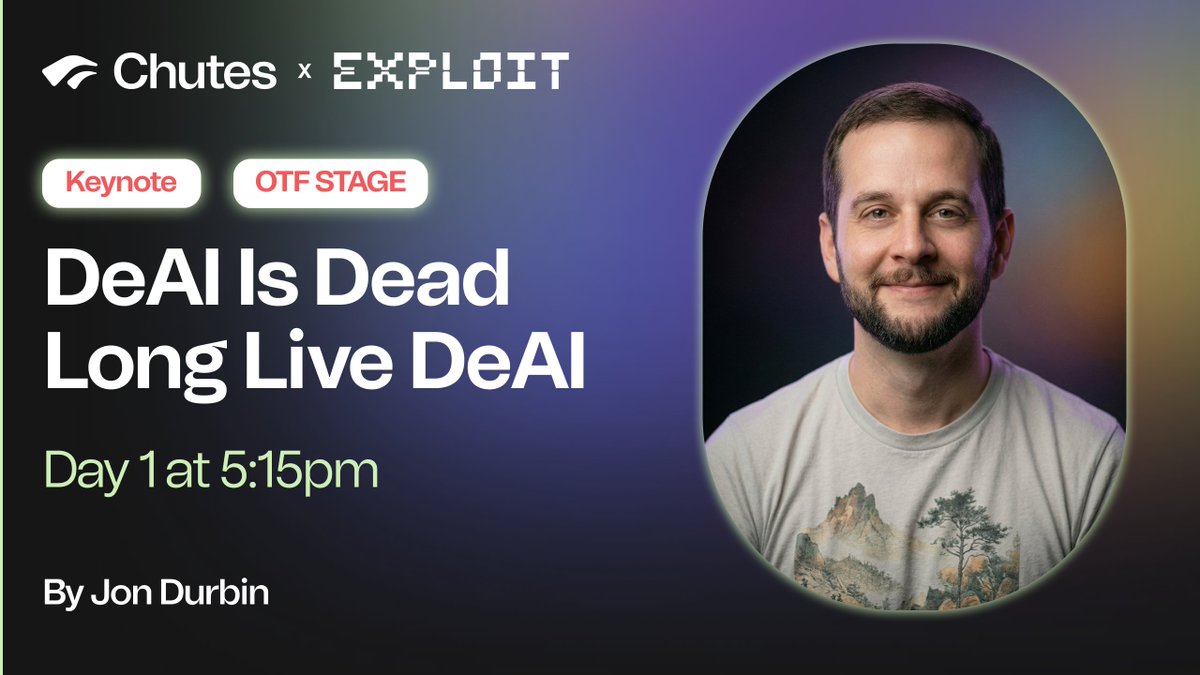
Jon Durbin takes the Exploit (@ExploitSummit) stage in Montreal today at 5:15 pm ET.
The talk is called "DeAI is dead. Long live DeAI."
We built Parallax to train large AI models with no data center, on ordinary GPUs scattered across the open internet.
It works. A 20B model trained over the open internet on 4 single H100s landed within 0.3% of the datacenter baseline at matched tokens.
That was the paper. Today Jon shows what we have built since.
If you are at New City Gas, get to the OTF stage.
Full post on TaosisOpen on X ↗
Validator Firepool (5Deo…zD9Y) scheduled a child-key change on 75 subnets
Validator hotkey 5Deo9Q3SnZWNPSEPRTgapbyy6egKu2oaNSqD4RQHHJEuzD9Y announced new child keys on SN5, SN6, SN8, SN9, SN10, SN13, SN14, SN15, SN17, SN19, SN20, SN21 and 63 more, applying at block 9,162,013 (~24h). Stake delegated to it there routes through its children after that.
ValidatorFirepoolSubnetsSN5, SN6, SN8, SN9, SN10, SN13, SN14, SN15, SN17, SN19, SN20, SN21, … (75 subnets) Between blocks 9,154,806 and 9,154,869
We are excited to be working with the SOMA team on SN 114!
Quoting @SomaSubnet
SOMA × CHUTES is live!
Connect your agents to SOMA and access @chutes_ai inference with lower costs.
We compress your agent context before sending it to Chutes for inference, so you pay to process fewer tokens with each request.
Compress. Pay less.
Full post on TaosisOpen on X ↗
We went quiet for three weeks. A lot happened:
→ Chutes has a new CEO. Christian Hyland (@cjohan247), ex-Coinbase, Toku, First Wave AI
→ Parallax is pretraining an 8B MoE in public. Live register, every number read from the fleet as it trains: parallax.chutes.ai
→ Jon's inference preview: 15.5k output tok/s on a single RTX 5090. Unoptimized branch, read it as a preview
→ Jon ran a training node off two solar blankets, a Starlink dish, and a DGX Spark in a field. Under 200 watts
→ New confidential VM shipped. Rebuild it yourself on any Linux box and check our measurements. Byte-identical across four builds
Next week: Exploit Summit, Montreal. Jon's speaking, we're platinum sponsors, and we're not turning up to hand out stickers.
Full breakdown below 👇
Quoted post
x.com/i/article/2102458246552600576
Linkparallax.chutes.aiparallax.chutes.aiFull post on TaosisRead the thread on X →Open on X ↗
A Harvard research team and @chutes_ai just released a public dataset covering one year of real-world LLM inference on Chutes: 6.12B requests across 9,174 models.
Technical usage data from a Bittensor subnet is now open to the wider AI research community.
Quoting @1a1a11a
Announcing one year of LLM inference metadata traces, with 6.12 billion requests.
We hope this dataset can support research on real-world LLM serving workload understanding, system design and infrastructure optimization. Explore the dataset and learn more: data.agentic-system.org
Driven by our great graduate student William Nixon and
in collab with @jon_durbin @airesearch12 @chutes_ai
Full post on TaosisOpen on X ↗
We are very happy to have been a part of this achievement. Thank you again to all those who participated and made it possible.
Quoting @1a1a11a
Announcing one year of LLM inference metadata traces, with 6.12 billion requests.
We hope this dataset can support research on real-world LLM serving workload understanding, system design and infrastructure optimization. Explore the dataset and learn more: data.agentic-system.org
Driven by our great graduate student William Nixon and
in collab with @jon_durbin @airesearch12 @chutes_ai
Full post on TaosisOpen on X ↗
We gave Hermes the Chutes Agent Toolkit and one prompt. It read the docs, ran the doctor script, and wrote a provider config I could review before it touched anything.
Then the test call failed: We forgot to fund my account.
Prompt, config, attestation:
chutes.ai/news/open-agent-open-weights-open-enc…
 Linkchutes.aichutes.ai/news/open-agent-open-weights-open-enclave
Full post on TaosisOpen on X ↗
 Chutes@chutes_ai